chinolog.md
Moldova’s single kennel portal · redesign
chinolog.md is the portal of Moldova’s Educational Cynology Centre, which works with the Kennel Union, an FCI member. I built a new site for it from scratch; it replaced the old Tilda version and now runs on chinolog.md. I keep refining it with the client’s notes.
- Role
- Design and full-stack
- Period
- Nov 2026 – present
- Context
- Freelance · client
- Format
- Remote · Chișinău
- Next.js 16 (static export)
- React 19
- TypeScript
- CSS Modules
- Supabase (Auth, Storage)
- Cloudflare Workers
- Turnstile
- Schema.org
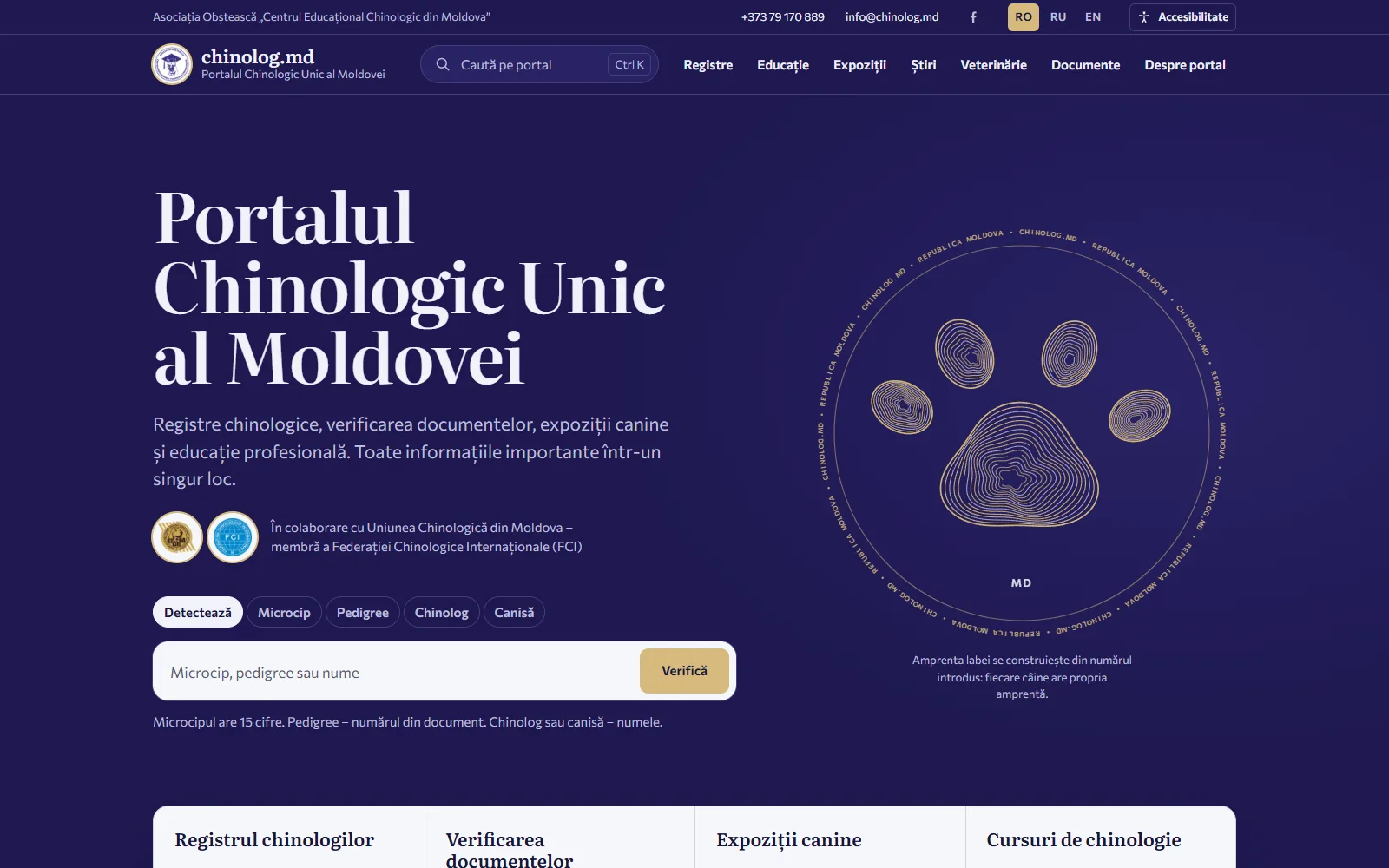
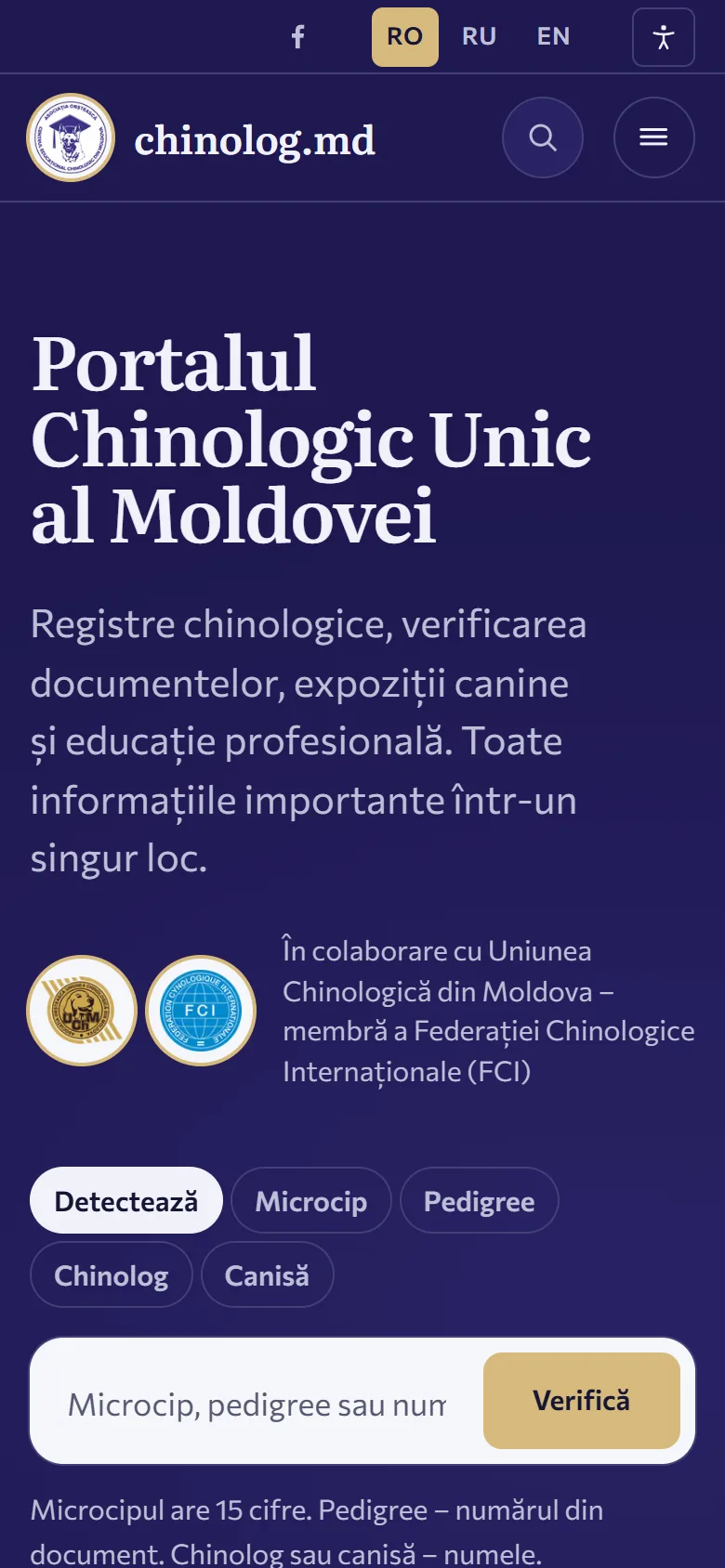
Before and after
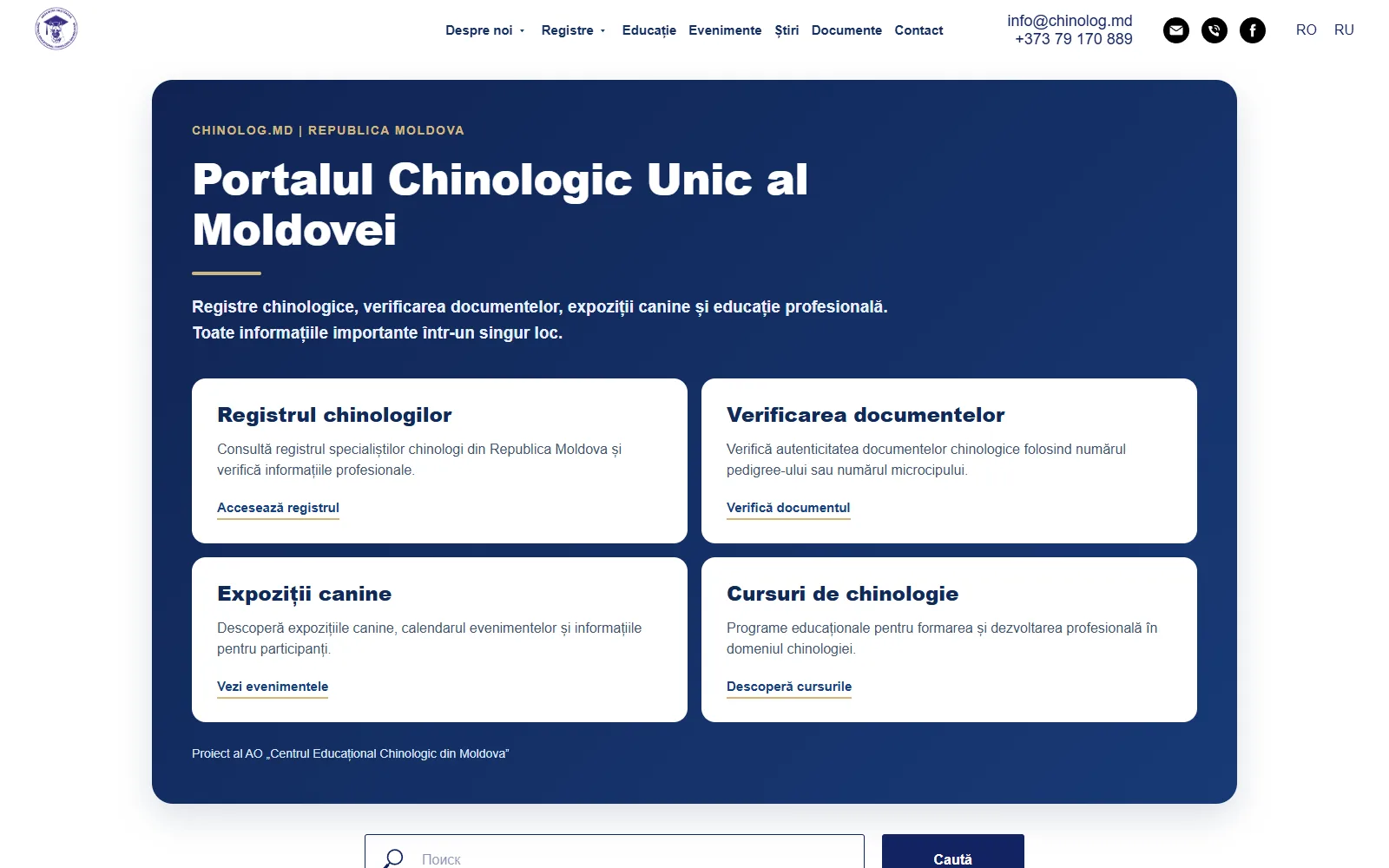
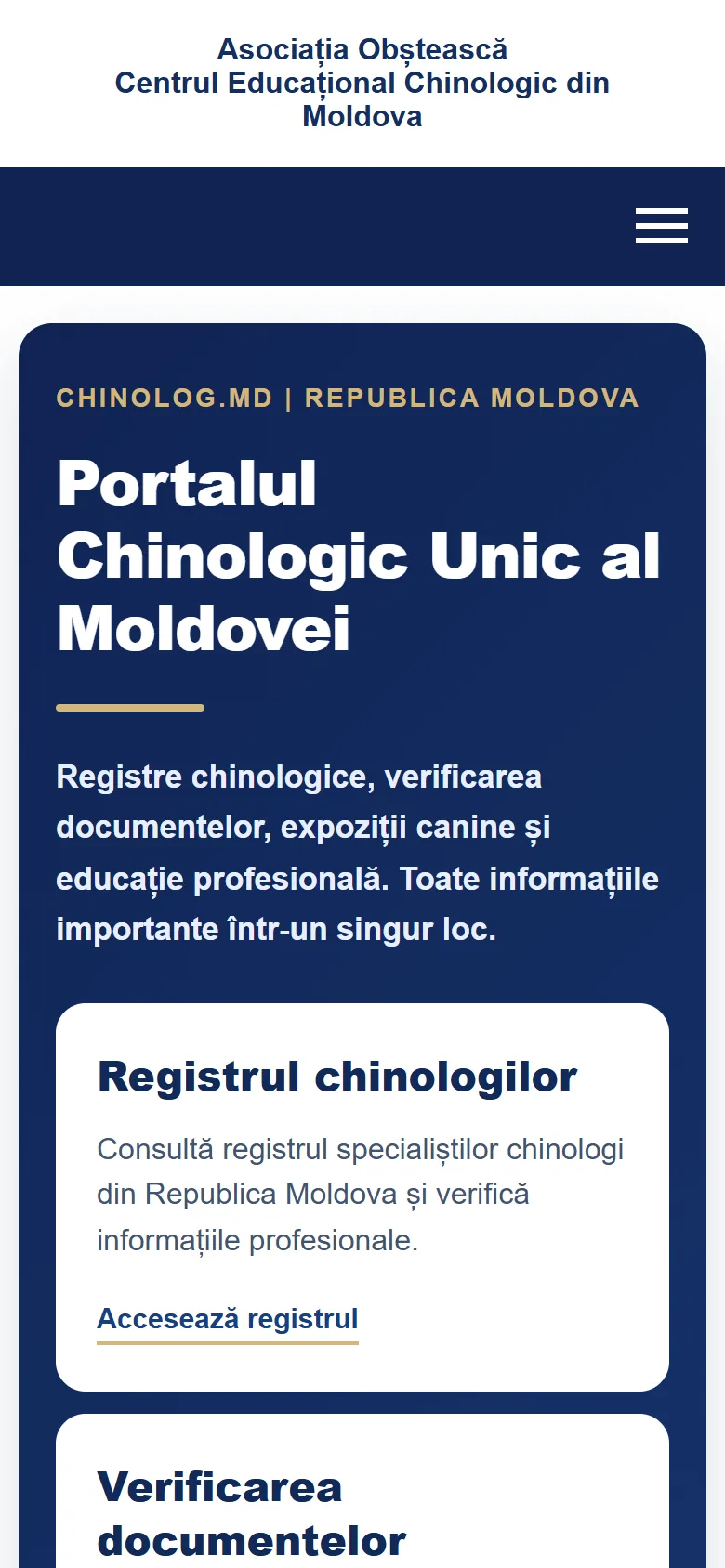
- The home page is 50 times lighter. All before-and-after measurements are below, under “Optimisation”.
- The first screen has one check field instead of four link cards: a microchip or pedigree number, or a handler or kennel name.
- The Russian version is fully in Russian, and every page has its Romanian and English pair.
The task
The old home page weighed 32 MB and made 97 requests. Pages had two canonical URLs and two H1s, language versions weren’t linked, and the Russian version kept a Romanian menu and cookie banner. First-aid articles were published as images, so search couldn’t see them.
- One field to check a dog, a handler or a kennel
- Registries you can search and filter
- Three languages with the same set of pages
- The client publishes news, shows and registry entries on their own
What I built
The portal
- The first screen is a single check field. The portal works out what was typed: a microchip number, a pedigree number, a handler or a kennel name. Each number draws its own paw print.
- Six registries with search and filters: handlers, kennels, rescue dogs and three registries of judges, 112 entries in all.
- Shows and events with a countdown and “in 4 days”, “on now” and “finished” states. A feed of 74 news posts with categories and authors.
- Site-wide search on Ctrl+K, document and certificate checks, a QR code made right in the browser, the Voluntary Dog Registry and a “I found a dog” section.
- Sign-up forms for courses, the registries, a vet and show organisers.
For visitors
- The design looks like a secure certificate, with paper, indigo from the seal on the logo and gold like foil.
- Three languages: Romanian, Russian and English. The switcher opens the same page in the other language.
- An accessibility panel with large text and high contrast. Analytics loads only after cookie consent.
- Photos open in a viewer with zoom and paging, with pinch on phones.
Admin
- The client runs news, pages, events, registries, partners, texts and files. A registry application turns into an entry with one button.
- Every edit has a version history with rollback. The “Publish” button rebuilds the site.
- Old Tilda addresses lead to the new pages, so the site keeps its search traffic after the move.
Outcome
- Lighthouse on mobile for performance, SEO and accessibility (was 87, 85 and 86)
- 100
- home page weight, down from 32.2 MB
- 0.64 MB
- requests on the home page instead of 97
- 23
- LCP on mobile, down from 2.3 s
- 1.1 s
The new site was checked against the old one: 41 pages from the sitemap, 112 registry entries and 72 news posts. The site is live on chinolog.md, and I keep working through the client’s notes.
Optimisation: before and after
Home page, Google Lighthouse runs from 11.11.2026. I counted images separately: what the browser downloads as soon as the page opens.
- Home page weight: 32.2 MB → 0.64 MB on mobile and 32.3 MB → 0.67 MB on desktop.
- Images on first load: 57 files, 32.5 MB → 3 files, 10 KB on mobile and 5 files, 68 KB on desktop. Images are cut into AVIF and WebP for the screen width, and the rest load on scroll.
- Requests: 97 → 23 on mobile and 97 → 26 on desktop. Instead of 48 page-builder scripts, the page arrives as ready HTML.
- Largest Contentful Paint: 2.3 s → 1.1 s on mobile and 0.9 s → 0.3 s on desktop. Cumulative Layout Shift: 0.18 → 0.
- Lighthouse on mobile: performance 87 → 100, SEO 85 → 100, accessibility 86 → 100. On desktop: 97, 85 and 80 → 100.